Cod: 189414
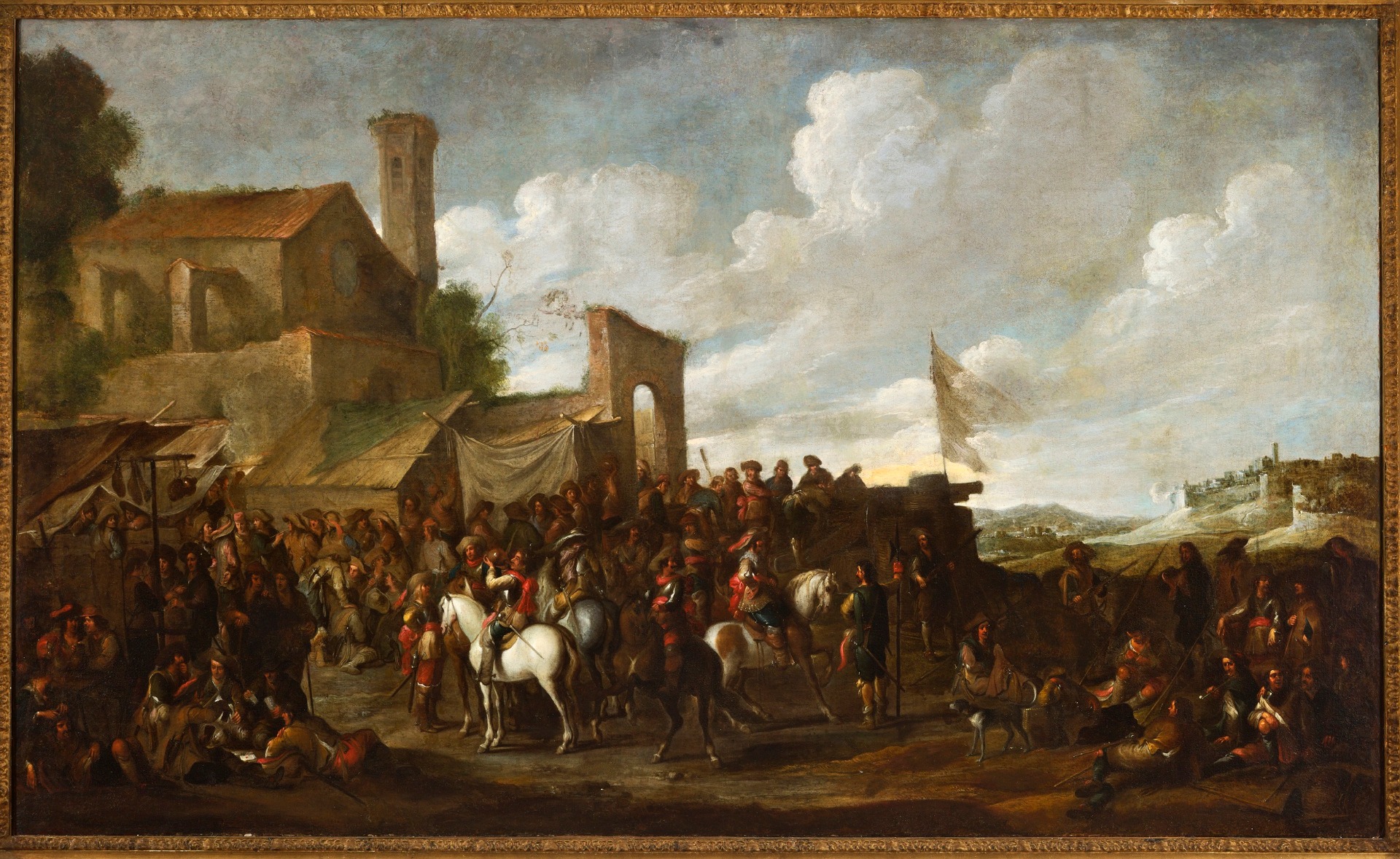
Soldiers' Encampment - SOLD
Author : Cornelis de Wael (Anversa 1592 – Roma 1667)
Period: 17th century
The Flemish painter Cornelis de Wael spent most of his life in Genoa, where he lived from 1616 until 1657 when, to escape the plague epidemic, he moved to Rome, where he remained until his death.
Cornelis played a fundamental role in the history of the city and in the artistic exchange between Italy and Flanders: painter and merchant, his house-workshop (also the residence of his brother Lucas for a few years) was a destination for many Flemish artists who arrived in Italy: among them Antoon van Dyck.
The choice of Genoa over other destinations (Rome, Florence, or Venice) stemmed from the fact that the city was then in strong growth and constant ferment, with potential clients and collectors and with a port that played a fundamental role for commercial exchange.
De Wael specialized in sea and land battles, as well as in bambocciate, a pictorial genre that developed in Rome in the 17th century, which combined the Flemish tradition (canvases populated by many figures) with representations of daily life of the time: urban scenes, festivals or theatrical performances in squares, descriptions of street trades (prostitutes, tooth pullers, gamblers, shoemakers) but also stories of travels and stops of troops.
The canvas is an example of a military subject bambocciata. It presents an army encamped close to some buildings (perhaps a village already looted) and a multitude of figures engaged in multiple activities.
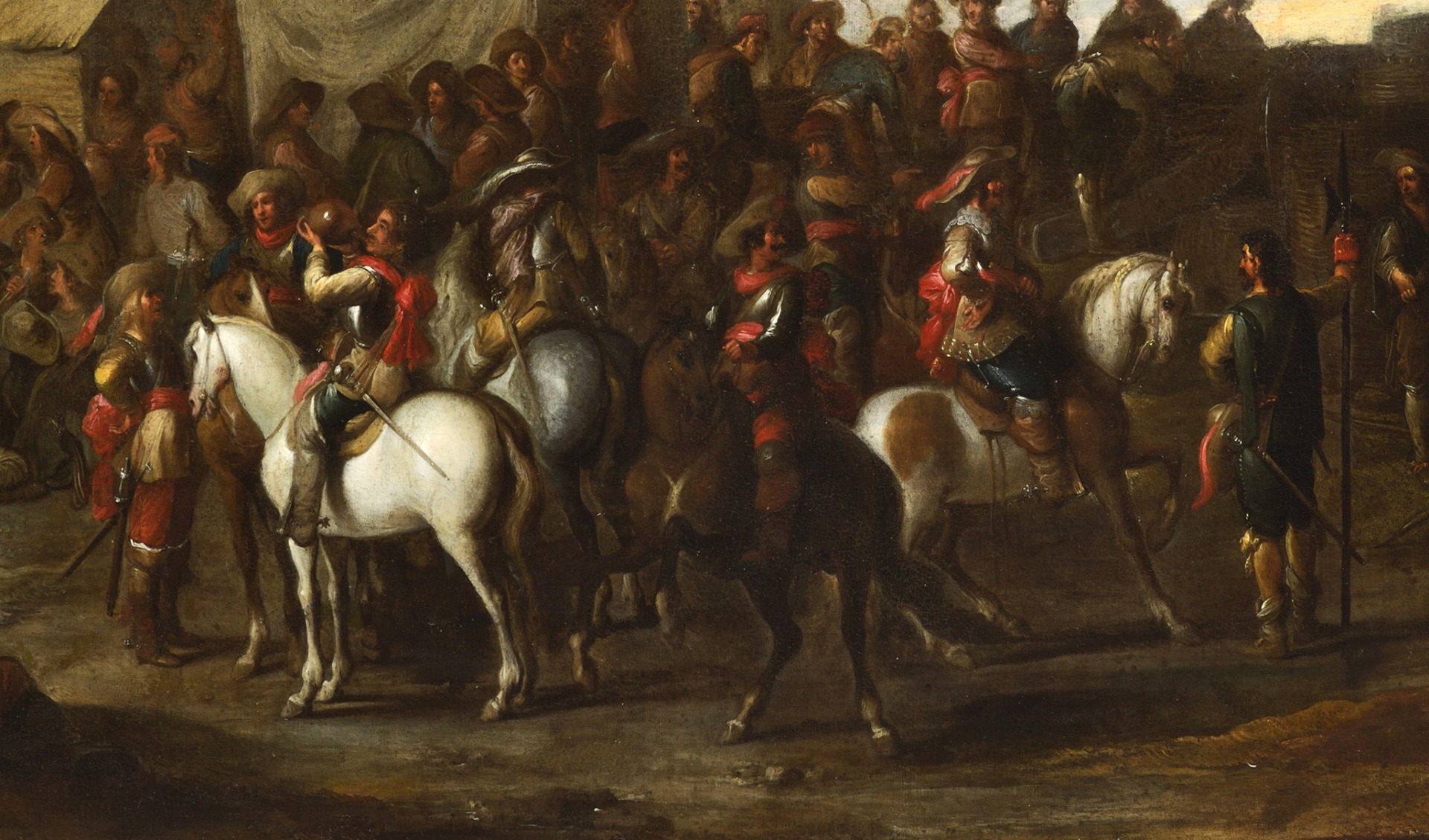
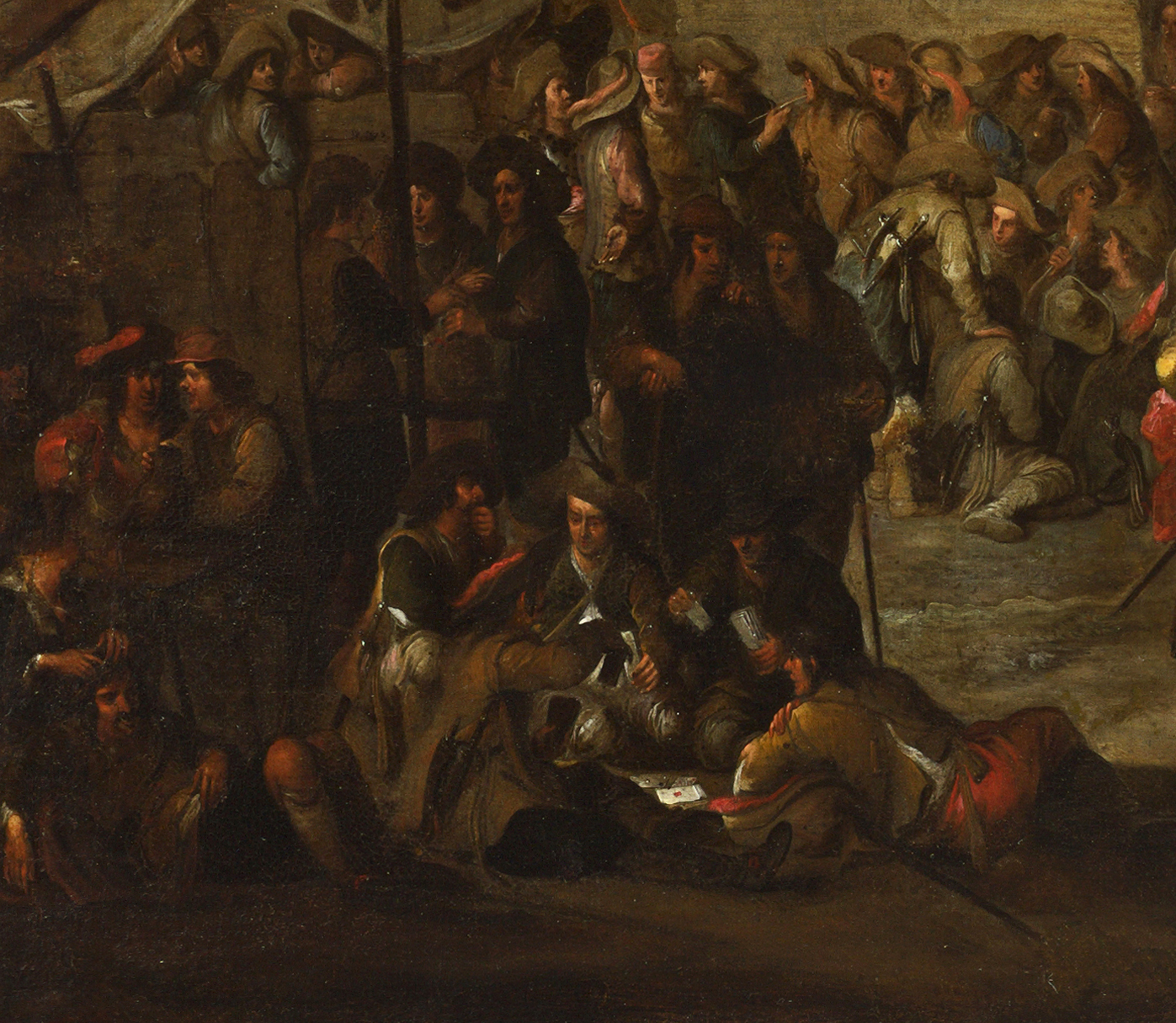
In the center of the scene, commanders on horseback are dressed in sumptuous clothes and wearing the corsaletto, a light armor that protected the chest and back. Standing, the sergeant, the figure with his back to us holding the halberd, takes orders. All around are the soldiers. There are those in charge of the cannon, a group is intent on playing cards, some sitting drink, others sleep or smoke, and all around, other soldiers talk to each other while a dog, perhaps the regiment's mascot, watches the scene.
A multitude of figures all in motion, meticulously described in the faces, characteristic of Cornelis, and in the clothing, an army recognizable not so much by a uniform but by a color, red, which each soldier wears even in various ways: a band tied around the waist, a scarf wrapped around the neck, a colored feather to adorn the hat.
The painting is accompanied by a card from Dr. Anna Orlando who makes an interesting comparison with the canvases Soldiers on Break and Clash of Soldiers kept in the Interiano Pallavicino palace in Genoa and published in Flemish-Genoese Painting, (U. Allemandi 2012, page 66), not ruling out the possibility that they could be part, together with ours, of the same series, given their size and the same "consonance of style".
The painting was exhibited at the exhibition Van Dyck and his friends. Flemish in Genoa 1600-1640 (Genoa, Palazzo della Meridiana, February 9 - June 10 2018), curated by Anna Orlando, pp. 260-261.
Dimensions: 97 x 162 cm