Item : 437774
Madonna
Author : Lorenzo Pasinelli (Bologna 1629 –Bologna 1700)
Period: 17th century
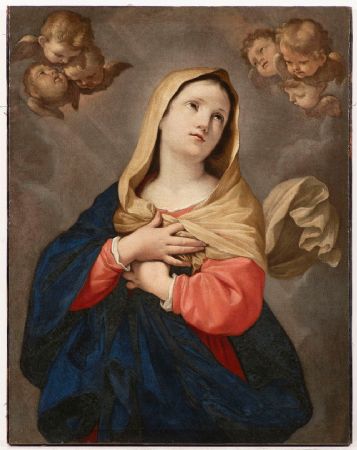
This beautiful painting depicting the “Madonna”, in excellent condition, is clearly attributable to the hand of Lorenzo Pasinelli (Bologna 1629 – Bologna 1700), an Italian painter of the late Baroque period.
He trained in the school of the Carracci and in the circle of Simone Cantarini, studied the works of Guido Reni and Guercino, managing to combine modernity and tradition of 17th-century Bolognese painting in his works.
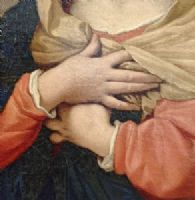
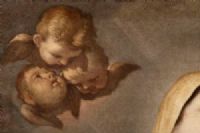
From a neutral background of sky and clouds, crossed by luminous rays, emerges the figure of the Virgin, participating in divine light; her gaze is turned upwards in contemplation, her arms are crossed and her hands are clasped on her chest in a sign of devotion. Above, both to the right and to the left, groups of three cherubs stand out, watching over the Madonna.
Our canvas shows a clear similarity to the famous painting, of identical subject, commissioned to the Bolognese painter by Prince Johann Adam of Liechtenstein in the early eighties of the seventeenth century. The latter, however, shows a different physiognomy of the Virgin, a darker background and the absence of the six cherubs.
Carmela Baroncini, author of the monograph dedicated to the painter, compares the painting preserved in the Liechtenstein Vaduz-Vienna collection to an etching preserved in Bologna (Pinacoteca Nazionale, Gab. dei Dis. e stampe, P.N. 5096, vol 11) and to three other examples at the National Institute for Graphics in Rome. These last ones show at the bottom, to the left, the writing “Lau Pasinellus Pin” and at the bottom to the right the letter D, which contains inside a small B, an element that induces the scholar to attribute the prints to the engraver Dotti.
Baroncini believes “….evident that this print reproduces the Madonna of Pasinelli for Liechtenstein” (C. Baroncini, Pasinelli, Rimini 1993, cards 51 and 119, pp. 264-266; 387-388). In reality, the engraving depicts in counterpart and in a precise way our painting which, not being known as a source of translation for the print, has led the scholar to erroneously associate the engraving with the painting now preserved in Vaduz-Vienna.
As for the chronology of the work, one can agree with an execution datable to the early eighties of the seventeenth century, therefore contemporary to the painting created for Prince Johann Adam Liechtenstein.
We are therefore faced with an unpublished work of extraordinary importance for the study of Pasinelli's activity and a fundamental addition to the Artist's catalog.