Item : 188785
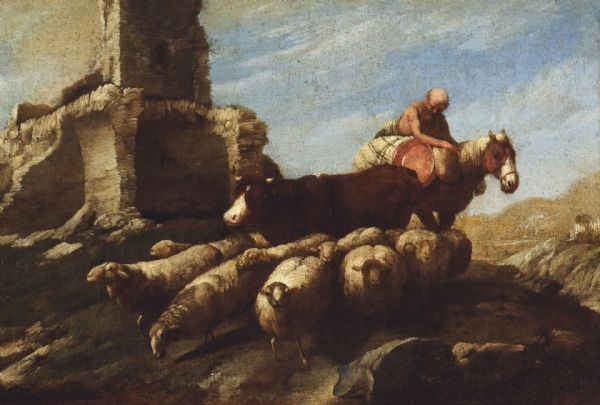
Landscape with ruins, traveler on horseback and herds - SOLD
Author : Antonio Travi (Sestri Ponente 1608 - Genova 1665)
Period: 17th century
From the painter's monograph: His peculiar and, in some respects, isolated production, constitutes a particular expression of the Genoese figurative language of the early seventeenth century …. (Zanelli, p. 7).
The first biography of Travi is by Soprani, and is defined by Zanelli as somewhat "romanticized": Chance joked in Antonio Travi by favoring him: he opened up a good opportunity: he went according to his ingenuity: and made him become a worthy Painter." "Bernardo Strozzi, nicknamed the Capuchin, … , needed a boy for household service, and especially for grinding colors. He had been looking for it for a long time; when he came across Antonio Travi [also called il Sestri, because he was a native of Sestri Ponente], a boy of very low condition, and almost a beggar, he seemed suitable; …. Travi was despised by misery, very poorly dressed, and moreover deafish. He had had no schooling except for the principles of reading, and of forming some letters (Soprani-Ratti, p. 304).
The boy, becoming fond of painting, while he was working for his Master, was observing his manners… Then secretly in his free hours he began to imitate him; sometimes copying figures, and sometimes making drafts (Ibidem, p. 305). So much so that Strozzi himself was amazed: ... how an idiot, at a tender age, without any instruction, had been able to do so much ... and therefore … He made him a disciple (Ibidem, p. 305).
Bernardo Strozzi was therefore his first teacher, fundamental for his training, but the knowledge with the German painter Wals, who came to Genoa in the twenties of the seventeenth century, marked a new way of painting: Goffredo Waals Flemish painter very expert in painting small landscapes with buildings, and architectures of various shapes, and views (Ibidem, p. 305).
Travi's style will subsequently evolve by looking at the production of Grechetto, and this delightful canvas, in excellent condition, is precisely an evident reference to the painting Flight of Sheep (Zanelli, fig. 18 p. 21) by Giovanni Benedetto Castiglione, kept at the Museo di Palazzo Rosso in Genoa.
Exhibitions: Exhibition of Genoese Painters of the seventeenth and eighteenth centuries (Palazzo Reale, Genoa, June-August 1938), curated by O. Grosso, M. Bonzi, C. Marcenaro.
Dimensions: 29 x 43 cm